When your mom’s trash management is too much
I know from talking to so many of you that aging parents often develop a unique relationship with trash. Yep, the trash. I can rationally understand that this has to do with maintaining control over something when many other areas of life may seem overwhelming. And yet, it is a mystery to me how so many older adults become obsessed with how the trash is managed – and ensuring that everyone follows protocol.
Here’s my family’s “Trash Talk”:
Trash management in my parents’ house is an involved and complex process. Whenever I visit I need a refresher course so as not to violate the well-established procedures. I always make at least one mistake the first day but quickly get back on track. My kids laugh about how many conversations there are around the trash at their grandparents’ home, but they do their best to comply.
As background (or rationalization), my parents live in California which has very specific rules on what’s trash, what’s compost, what’s recycling and residents are expected to follow along. I 100% support the intention behind this. Growing up in Connecticut in the 70’s, there was no recycling. People had these ridiculous “trash compactors” in their kitchen and everything went in it. You flipped a switch and it smashed everything down creating a heavy, brick-like bag of trash that must’ve weighed a ton. (I wouldn’t know – I was a teenager who never emptied the trash, sorry to admit.)
My mom worked very hard with the city council to help bring what we now know as “curbside recycling” to our community. I am very proud of her efforts to improve our environment. But fast forward to 2024.
Perhaps, like us, you have a cabinet that pulls out to reveal two hidden bins: one intended for trash and the other intended for recycling items like glass jars, cans, bottles, newspapers, etc. It’s fairly straightforward. Seemingly. Here are the rules in my mom’s house:
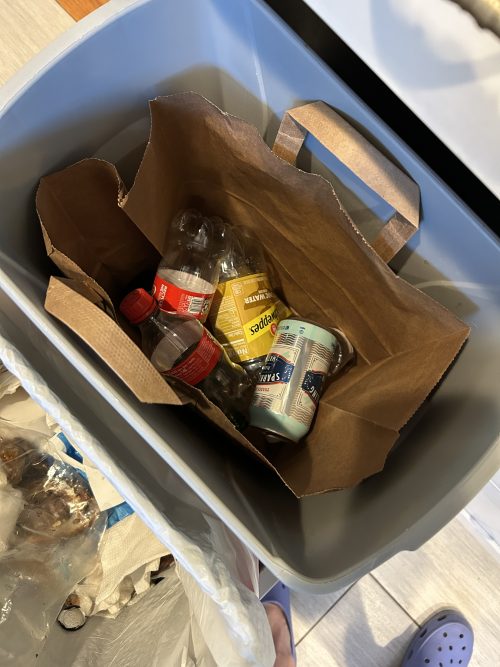
Rule 1: Never put soda bottles, beer bottles, or cans in the recycling! Thanks to the bottle deposit program, somewhere, somehow they are worth $.05 each!
Let’s just say, aggressively, 2 retired people a day go through 2 $.05 bottles a day. This is an extreme scenario. While my dad loves his mini bottled Cokes, it probably takes 2 days for him to finish one. So, in an incredibly busy month of beverage consumption, they may generate about 60 bottles or cans. This would net $3 a month in deposit fees that can be returned for cash – if you could figure out where to do this.
If the recycling side of the trash drawer is taken up with bottles that need to go to church, where does the recycling go?
Front Bin: Trash
Rear Bin: Returnable bottles
For years, my mother drove them to a machine at the recycling center until these machines disappeared and they forbade citizens from doing this. Given the cost of gas in California, it probably cost more in gas at $4.50 a gallon than the bottles are worth. She was probably the last lady they had to pry away before locking the machine off behind a chain-link fence at the dump. I can picture her smiling face clutching at the gate with a Vons bag full of coke bottles while the door slowly swings shut. Today, the grocery stores won’t take them back either.
For a while she found a way to give the bags to unhoused people so they could get the cash, which was admirable, but now that’s not really feasible. She takes them to church where she claims a young person changes them for cash for a worthy cause. We are skeptical and think this nice person pops them right in the recycling bin. Regardless, this saves my mom the emotional trauma of throwing away a nickel. And yet, they take up 50% of the trash space in our kitchen and about 20% of our mental energy.
If the recycling side of the trash drawer is taken up with bottles that need to go to church, where does the recycling go?
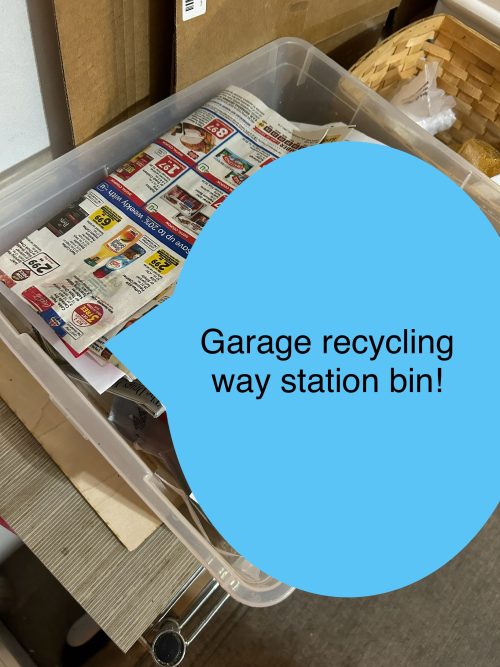
Rule 2: Other recyclable items wait in plastic bin (sometimes a plastic recyclable lettuce box) on a shelf in the garage until it’s ready for the bin.
All recyclable items that do not have a deposit paid, and in California this is A LOT of stuff, are temporarily housed in the “recycling way-station.” Once it’s full, it may be dumped into the gigantic blue recycling bin outside. There is at least one verbal exchange a day clarifying if an item goes in the recycling way-station, trash, or the deposit bottle bin. If something goes into the blue bin without approval, it will be retrieved if spotted by my mom. Often, this could be the perfect piece of cardboard!
The Recycling Way-Station where recyclables wait for their turn to get tossed in the big blue bin.
Rule 3: Food waste goes in the freezer. Yes, the freezer. In a recycled plastic coffee container.
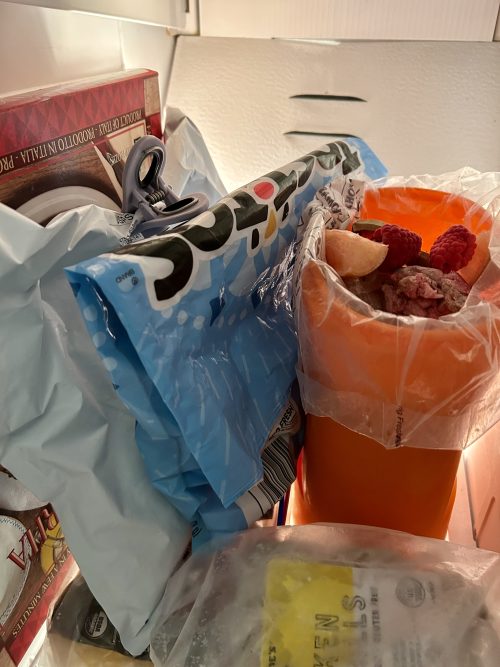
Now, I have an incredible sense of smell, so I kind of get this. If you compost, as is “required” in California, you have to consider when to put food waste into the big green bin outdoors to mitigate odors and the risk of racoons storming your trash. If you freeze potentially stinky food waste and put it in the trash on trash day, there’s no smell and fewer critters.
However, this may occasionally cross over to the absurd. As seen above, we not only have the coffee container full of meat and fruits, but also a Tostito’s bag with some nacho crumbs in the freezer awaiting their death march to the bin, and a plastic Amazon shipping bag being re-used as a frozen lettuce storage receptacle.
Taking up the prime freezer real estate with rotting food is only feasible if you don’t have to fill your freezer full of actual edible food, so it probably won’t work if you have kids. Or if your kids come to visit, they will freak out that the freezer seems to be a health hazard and throw it all out in a tightly tied Hefty bag and take it to the bin 2 days early. Trust me, it will be okay. Racoons will not swarm.
One caveat: Coffee Grinds – coffee grinds do not go in the trash or the freezer. They are held in escrow in the sink and brought out to a large planter on the back patio where they get mixed in with dirt to be future compost. My parents’ grass is astroturf, so….you can ponder this for yourself.
Rule 4: Find the right bin!
My parent’s house of 2 people has 5 huge curbside trash cans in 3 colors lined up, waiting to be filled. Green for compost (1), blue for recycling (1), black for trash (3). Honestly, after following the advanced trash management procedures, there’s not much actual trash. So why do 2 retired people need 5 bins? My house of 4 people has gotten by on 2 big bins for the last 25 years so 5 seems like a lot.

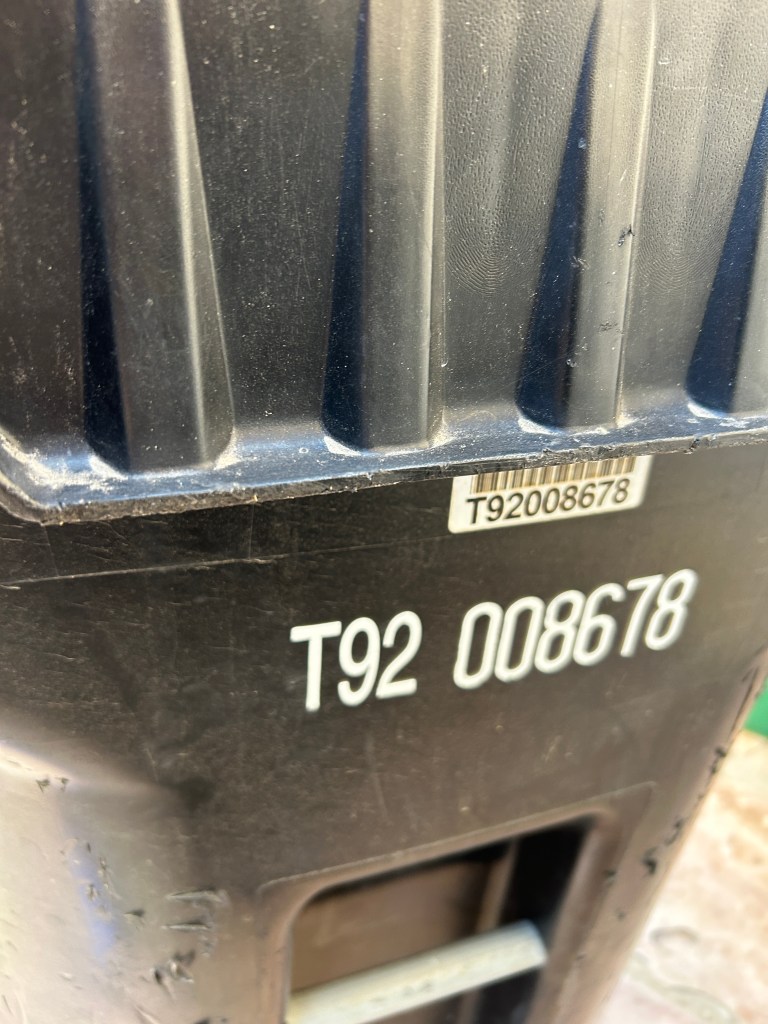

So in California, the city provides the trash service, not a private company. I called to inquire about getting my parents smaller, more manageable bins and perhaps returning some of the extras. “Sure! You may purchase a smaller bin” I was told. “If you want to return any of the old bins, feel free to bring them down to our warehouse or just break them up into smaller pieces and put them in the trash.” Sorry, whaaaaat? How exactly would you propose my 90-year-old dad “break down” a plastic trash bin and get it in his new, smaller bin? Perhaps this is why so many houses in California seem to have an overabundance of trash cans laying around.
It seems the trash comes full circle, one way or another.
What are the idiosyncrasies around trash in your house? Please share any suggestions for making this a less onerous and anxiety-provoking process!
 Who Gets The China?
Leave a comment